
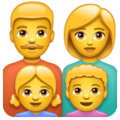
👨👩👧👦 Family: Man, Woman, Girl, Boy Emoji

Emoji
👨👩👧👦 Emoji Information
- Name:
- Family: Man, Woman, Girl, Boy
- Shortcode:
- :family_man_woman_girl_boy:
- Software Shortcodes:
-
:family_man_woman_girl_boy: ( Github )
:family_mwgb: ( Discord )
:man-woman-girl-boy: ( Slack ) - Keywords:
- boy, family, girl, man, woman
- Category:
- People & Body » Family
- Introduced:
- 2010 ( Unicode 6.0 )
- Unicode Codepoint(s):
-
👨U+1F468
U+200D
👩U+1F469
U+200D
👧U+1F467
U+200D
👦U+1F466
- Modifier:
- Not Available
👨👩👧👦 Family: Man, Woman, Girl, Boy Meaning
The family: man, woman, girl, boy emoji represents a typical nuclear family structure, usually comprising a father, mother, daughter, and son. The emoji is often used to signify family bonds, unity, and togetherness. It is a universal depiction of familial relationships and is often employed in digital communication to convey sentiments related to family life, such as love, support, and mutual care. This emoji configuration underscores a traditional family archetype which many people can easily identify with.
Beyond its literal representation, this emoji can be a powerful symbol for connecting with one's roots and heritage. For instance, using this emoji might accompany messages about family gatherings, holidays, or other celebrations that involve family members. It can signify the importance of these relationships and act as a visual shorthand to quickly convey the essence of familial interactions without the need for elaborate explanations. Additionally, it can evoke feelings of nostalgia and remind individuals of the cherished times spent with their loved ones.
In a broader context, the family: man, woman, girl, boy emoji might also be employed to touch upon societal issues related to family dynamics, gender roles, and the evolution of family structures over time. While it primarily represents a heterosexual nuclear family, it opens discussions around inclusivity and diversity in modern family configurations. Consequently, this emoji not only fosters an emotional connection but also serves as a starting point for larger conversations about what constitutes a family in contemporary society.
The family: man, woman, girl, boy emoji was introduced in 2010 and released as part of the Unicode 6.0 standard. This emoji can be found under the people and body category. Because the family: man, woman, girl, boy emoji has been around for quite some time, it should display correctly in the majority of operating systems.
👨👩👧👦 Examples and Usage
Here are some practical examples of how this emoji can be used in various conversations, social media posts, or messages. These sentences provide context to highlight the emoji's meaning, emotions, and situations it commonly represents. Whether you're expressing your mood, making a statement, or simply adding some fun to your text, these examples can help inspire your own creative use of this emoji. Feel free to adapt or personalize them for your needs!
- We had an amazing day at the beach 👨👩👧👦🌊🏖️!
- Family game night tonight! 👨👩👧👦🎲🎮
- Happy holidays from our family to yours! 🎄✨👨👩👧👦
- Weekend camping trip with the family 👨👩👧👦🏕️🔥
👨👩👧👦 Emoji on Different Devices
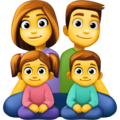
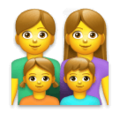

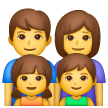
Here, you'll find a variety of emojis showcasing how they appear across different operating systems. Each company designs emojis to reflect their own unique style, meaning the appearance of the same emoji can vary depending on the platform. We've gathered the most popular platforms to give you a glimpse of how these emojis will look on their respective screens.
Keep in mind that depending on the version of the operating system, the emoji images may still look slightly different from what you see here. For your convenience, you can download any of the images by clicking on the symbol next to each one.




👨👩👧👦 Worldwide Trend
Stay updated with the latest global trends using data from Google Trends. This section provides insights into how frequently emojis are being searched on the web over the past 12 months. Explore the current trends to see which emojis are gaining popularity worldwide.
👨👩👧👦 Developer Codes
In this section, you'll find the essential codes developers use to integrate and display emojis across various platforms. Whether you're working with HTML, CSS, or other programming environments, these codes will help ensure that the emojis render consistently and correctly in your projects.
- Shortcode:
- :family_man_woman_girl_boy:
- Software Shortcodes:
-
:family_man_woman_girl_boy: ( Github )
:family_mwgb: ( Discord )
:man-woman-girl-boy: ( Slack ) - Hex Code:
-
👨‍👩‍👧‍👦 - Decimal Code:
-
👨‍👩‍👧‍👦 - Punycode:
-
xn--oq8hbce - URL Escape Code:
-
%F0%9F%91%A8%E2%80%8D%F0%9F%91%A9%E2%80%8D%F0%9F%91%A7%E2%80%8D%F0%9F%91%A6 - JavaScript & JSON:
-
\ud83d\udc68\u200d\ud83d\udc69\u200d\ud83d\udc67\u200d\ud83d\udc66 - CSS Code:
-
content: '\1F468 \200D \1F469 \200D \1F467 \200D \1F466';